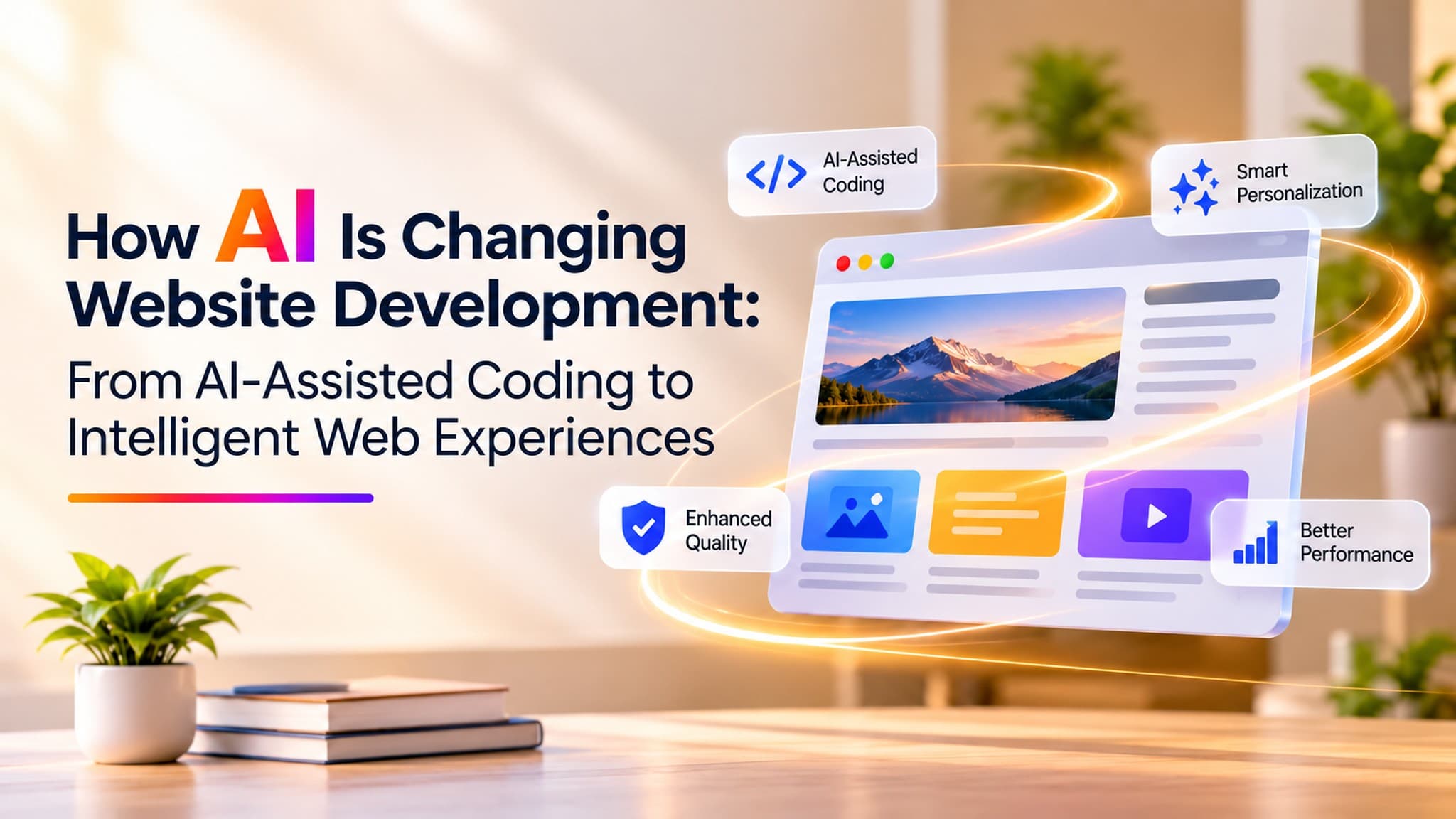
How AI Is Changing Website Development: From AI-Assisted Coding to Intelligent Web Experiences
Key Takeaways
- 1AI-assisted coding can help developers work faster, but generated code requires review
- 2AI can support test generation, error analysis, and quality assurance.
- 3Intelligent search, chat assistants, and recommendations can make websites more interactive.
- 4AI-driven personalization can create more relevant visitor experiences when supported by appropriate data.
- 5AI can assist with website monitoring, maintenance, and optimization.
- 6Businesses should adopt AI based on real requirements, security considerations, and measurable outcomes.
Website development has traditionally involved several stages: understanding requirements, designing interfaces, writing code, testing functionality, and maintaining the finished website. While these fundamentals remain important, artificial intelligence is changing how development teams approach each stage.
Today, AI can assist developers with writing code, identifying errors, generating test cases, analyzing user behavior, and creating more responsive digital experiences. It is also changing what businesses expect from their websites. Instead of serving only as platforms for displaying information, websites can now support more interactive and intelligent user journeys.
However, the real opportunity is not simply using AI to develop websites faster. It is understanding where AI can improve development quality, simplify operations, and create better experiences for visitors.
AI Is Changing the Way Developers Build Websites
One of the most visible changes is the introduction of AI-assisted coding into everyday development workflows.
Developers can use AI coding assistants to generate code suggestions, explain unfamiliar code, identify potential errors, and help with repetitive programming tasks. For example, when building a registration form, an AI assistant can help draft validation logic, suggest improvements, or explain how a particular function works.
This can reduce time spent on routine development activities and help developers explore different implementation approaches.
However, AI-generated code still needs human review. Developers must verify its accuracy, security, performance, and compatibility with the existing application. Code that works in a small example may not be suitable for a production website.
AI can accelerate development, but engineering judgment remains essential.
From Manual Testing to AI-Assisted Quality Checks
Website testing is another area where AI is creating new possibilities.
Traditional testing often requires developers and quality assurance teams to write and maintain test cases for different user journeys. As websites become more complex, testing every interaction across browsers, devices, and application states can become increasingly demanding.
AI-assisted testing tools can help generate test scenarios, identify patterns in failures, and prioritize areas that may need attention.
Consider an online booking website. Its important user journeys might include searching for a service, selecting a date, entering customer details, and completing a booking. AI-assisted testing can help teams create scenarios around these interactions and identify potential issues.
This does not eliminate the need for manual testing. Complex workflows, usability concerns, security requirements, and unexpected user behavior still require careful human evaluation.
The benefit is a more efficient testing process that allows teams to focus on the areas where quality matters most.
Websites Are Becoming More Intelligent and Interactive
AI is also changing what happens after a website goes live.
Previously, most websites presented the same navigation, content, and functionality to every visitor. Businesses could personalize experiences through predefined rules, but adapting interactions to individual user needs often required considerable development effort.
AI-powered capabilities make more dynamic experiences possible.
For example:
AI chat assistants: Help visitors find information, understand services, and get answers to common questions.
Intelligent search: Understand search intent and help users find relevant information beyond exact keyword matches.
Personalized recommendations: Suggest relevant products, services, or content based on available user context.
Content assistance: Support content discovery and help visitors navigate large information libraries.
Automated workflows: Connect website interactions with internal systems to reduce repetitive tasks.
A B2B software company's website, for example, could use an AI assistant to answer questions about its services, direct visitors to relevant case studies, and help them identify the right solution.
The goal is to make the website more useful, not simply add an AI chatbot because the technology is available.
Personalization Is Moving Beyond Basic Recommendations
Personalization is becoming more important as businesses compete for user attention.
Traditional personalization often relies on fixed rules, such as displaying different content based on location or previously selected preferences. AI can help analyze available behavioral signals and identify patterns that support more relevant experiences.
For example, a visitor exploring healthcare software development services may be shown related case studies, relevant technical resources, or information about healthcare integrations.
An eLearning platform could recommend courses based on a learner's previous activity and interests. A SaaS website could guide visitors toward features that match their stated requirements.
These experiences depend on the quality of the available data, appropriate consent, and responsible handling of user information. AI recommendations should also remain relevant and transparent rather than making assumptions that visitors cannot understand or control.
AI Is Changing Website Maintenance and Optimization
Website development does not end at launch. Performance monitoring, bug fixing, security updates, content improvements, and compatibility checks remain ongoing responsibilities.
AI can support these activities by helping teams analyze application logs, identify unusual patterns, summarize errors, and investigate possible causes of performance issues.
For instance, if users repeatedly encounter errors during a checkout process, AI-assisted analysis may help developers identify patterns in the affected sessions or error reports. The team can then investigate and implement an appropriate fix.
AI can also assist with analyzing website content and user interactions to identify opportunities for improvement.
It should not replace established security practices, backups, monitoring systems, or developer-led investigation. Instead, it can make maintenance activities more informed and efficient.
What Businesses Should Consider Before Adopting AI in Website Development
Not every website needs advanced AI capabilities. The right approach depends on the business model, audience, technical requirements, and problems the website needs to solve.
Before introducing AI, businesses should consider:
1. Identify a real use case: Start with a specific problem, such as repetitive customer queries, difficult content discovery, or time-consuming testing.
2. Evaluate data requirements: Determine what information the AI feature needs and whether that information can be collected and used appropriately.
3. Plan for integration: Consider how the AI capability will connect with the existing website, databases, CRM, APIs, or other business systems.
4. Review security and privacy: Protect user information, apply appropriate access controls, and assess how data is processed and stored.
5. Measure the results: Track outcomes such as reduced support workload, improved task completion, faster testing, or increased engagement.
A clearly defined use case is more valuable than adding multiple AI features without understanding their purpose.
The Future of Website Development Is Human-Led and AI-Assisted
AI is changing website development at both the engineering and user-experience levels. Developers can use it to accelerate repetitive tasks, testing teams can improve quality checks, and businesses can introduce more intelligent ways for visitors to interact with digital platforms.
But successful implementation still depends on understanding the problem, choosing suitable technologies, reviewing AI-generated outputs, and building reliable systems.
At Vivansh Infotech, website development can extend beyond traditional design and coding to include AI integrations, intelligent web applications, automation, and custom digital solutions.
The businesses that benefit most from AI will not necessarily be those that use the most tools. They will be the ones that apply the technology where it creates genuine value for their users and operations.
Frequently Asked Questions
How is AI changing website development?
AI is helping developers write and review code, generate test cases, analyze errors, and build intelligent website features such as chat assistants, personalized recommendations, and smart search.
Can AI build an entire website?
AI tools can generate website layouts, code, and content, but a production-ready website still requires requirements planning, technical validation, security checks, testing, and ongoing maintenance.
What is AI-assisted coding?
AI-assisted coding uses artificial intelligence to suggest code, generate functions, explain programming logic, identify potential errors, and support developers during software development.
How can AI improve website user experience?
AI can improve user experience through intelligent search, conversational assistants, personalized recommendations, and automated interactions that help visitors find information or complete tasks.
Is AI-powered website development suitable for small businesses?
Yes. Small businesses can start with focused applications such as customer support chatbots, intelligent search, or automated workflows. The right solution depends on their needs and budget.
Will AI replace website developers?
AI can automate certain repetitive development tasks, but developers remain essential for architecture, problem-solving, security, integration, quality assurance, and making technical decisions.