Digital Transformation in the Petroleum Industry: Modernizing Digital Platforms
Key Takeaways
- 1Modernize websites to make technical information and digital services easier to access.
- 2Migrate technical publications and documents while preserving metadata, URLs, and access permissions.
- 3Improve document management through structured content, version control, and publishing workflows.
- 4Connect existing applications using APIs, single sign-on (SSO), and role-based access control.
- 5Decide when to integrate, upgrade, or replace legacy systems based on business needs, security, and maintenance costs.
- 6Measure modernization results through performance, search success, migration accuracy, and platform reliability.
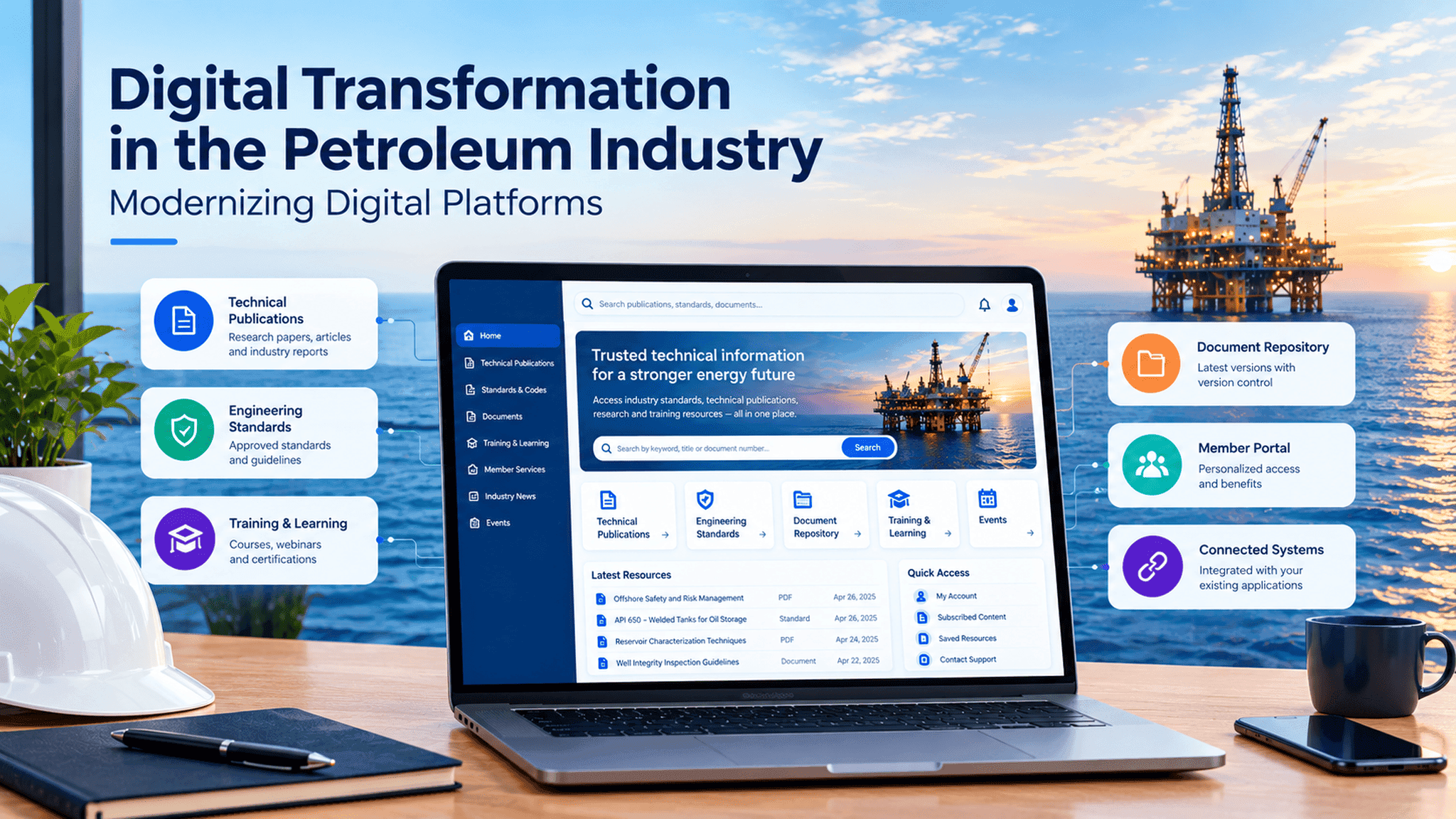
Petroleum and energy organizations manage more than operational data. They also maintain technical publications, engineering standards, research libraries, training materials, industry databases, and digital services for professionals and business partners.
When these resources are spread across legacy websites and disconnected applications, finding the right information can become difficult. Teams may need to update content in multiple places, users may face separate logins for different services, and older systems can become increasingly expensive to maintain.
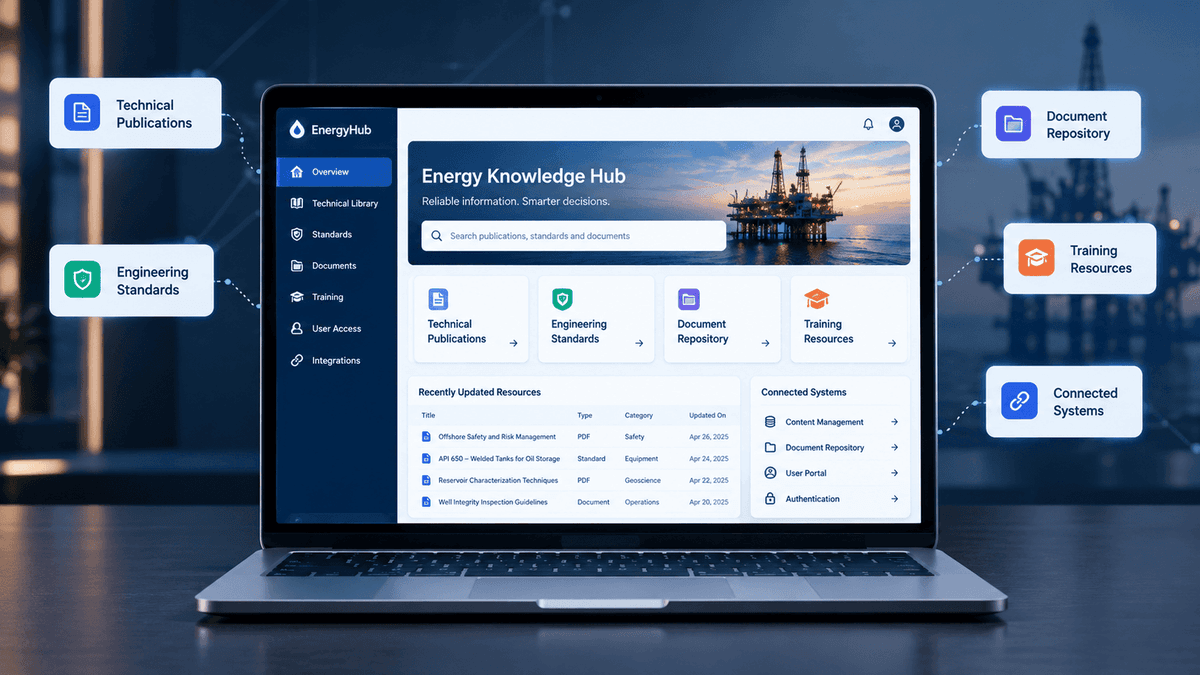
Digital transformation helps address these challenges by connecting websites, content management systems, document repositories, membership platforms where applicable, and other business applications. The goal is to make technical information easier to find, simplify access to digital services, and reduce the effort required to maintain the underlying systems.
For petroleum and energy organizations, successful modernization means improving how information is published, accessed, and managed - not simply launching a new website.
The next step is to identify which parts of the digital ecosystem need attention first, from technical content discovery and document control to application integration and legacy system modernization.
Common Digital Challenges in the Petroleum Industry
Different petroleum and energy organizations have different digital requirements. However, those managing large content libraries, professional resources, business applications, or member services may face similar challenges.
Digital requirement | Common challenge | Modernization approach |
Technical publications | Difficult search and inconsistent categorization | Structured content, metadata, and improved search |
Engineering documents | Users struggle to identify the latest approved version | Document version control and publishing workflows |
Training resources | Learning materials are spread across separate platforms | Integration between content and learning systems |
Member or customer services | Separate accounts and inconsistent access permissions | Connected account and access management |
Industry databases | Older applications are difficult to maintain or extend | API integration or phased modernization |
Content administration | Teams update the same information in multiple places | Connected workflows and clearer data ownership |
The right approach depends on the existing technology and the problems that matter most to the organization. Replacing every system is not always necessary; sometimes, improving how applications work together delivers more value.
5 Areas to Focus on During Digital Transformation
1. Modern Website Development
A website often serves as the main entry point to an organization's digital services. It should give visitors a clear path to the information and services they need, from technical resources and industry updates to learning materials and event details.
For petroleum and energy organizations, website modernization can include:
Clear navigation for technical and business audiences.
Search and filtering across publications and resources.
Mobile-friendly layouts for professionals accessing information on different devices.
Content management tools that simplify publishing and updates.
Integration with existing applications and databases.
A modern website should also accommodate future requirements without requiring a complete rebuild every time a new service is introduced.
2. Technical Content Migration
Research papers, engineering documents, technical articles, and archived publications can represent years of accumulated organizational knowledge. Moving them to a new platform requires more than transferring text and images.
Content relationships, metadata, categories, URLs, and access permissions may also need to be preserved.
Before starting a migration, check:
Which content needs to be transferred, archived, or removed?
Which documents are public, restricted, or available only to specific users?
How should categories, tags, and metadata map to the new platform?
Which existing URLs need to be retained or redirected?
How will missing records, broken links, and access permissions be validated?
A structured migration process helps reduce content loss, protects search visibility, and makes the new platform easier to maintain.
3. Document Management and Version Control
In technical environments, finding a document is only part of the requirement. Users may also need to know whether it is current, approved, or superseded by a newer version.
Where engineering standards, technical guidance, procedures, or controlled documents are published online, the platform should support clear document identification and publishing rules.
Depending on the organization's requirements, useful capabilities may include:
Document categories and searchable metadata.
Version history and publication dates.
Review and approval workflows.
Permissions for viewing or updating restricted documents.
Clear identification of current and archived versions.
A website or content management system may provide some of these capabilities, while more complex document-control requirements may call for a dedicated system. The decision should be based on the level of control the organization needs.
4. System Integration and Secure Access
Petroleum and energy organizations may use separate applications for content publishing, customer accounts, training, subscriptions, research resources, and internal operations.
When these applications operate independently, users may have to sign in multiple times, and teams may need to maintain the same information in several systems.
Integration can help create a more consistent experience.
For example, a user signs in through an approved identity system, their permissions are verified, and the connected application provides access to the resources they are authorized to use.
Depending on the systems involved, integration may use:
Single sign-on (SSO): Reduces repeated sign-ins across compatible applications.
APIs: Allow applications to exchange information and trigger workflows.
Role-based access control: Assigns permissions according to user roles and responsibilities.
Custom integrations: Connects legacy applications that lack suitable standard connectors.
Security should be considered throughout implementation, including identity verification, access permissions, credential handling, logging, and the protection of sensitive information.
5. Performance and Ongoing Maintenance
A modern interface will not solve every problem if the underlying platform remains slow or unreliable.
Performance improvements may involve database optimization, caching, API response times, image and file delivery, hosting configuration, and unnecessary application processes.
After launch, monitoring helps teams identify issues before they significantly affect users.
Useful areas to review include:
Page load and application response times.
Search performance across large content libraries.
Availability of connected applications.
Authentication failures and access-related support requests.
Security updates and software dependencies.
Maintenance effort and recurring production incidents.
The objective is to make measurable improvements and keep the platform reliable as requirements change.
Should You Replace a Legacy System or Integrate It?
Not every older application needs to be replaced. A system may still perform its core function well but need better integration with the rest of the digital environment.
Use the following framework when evaluating the options.
Consideration | Integrate the existing system | Consider replacement |
Functionality | Meets current business requirements | Important capabilities are missing |
Integration | Suitable APIs or connectors are available | Integration is impractical or too costly |
Security | Can be maintained and secured appropriately | Critical limitations cannot be resolved |
Maintenance | Support remains available and manageable | Maintenance risk or cost is increasing |
Long-term plans | Can support expected growth | Architecture limits future development |
Practical rule: Retain systems that continue to meet business needs and can be maintained securely. Consider replacement when their limitations create ongoing security, operational, or financial problems.
A technical assessment can help determine whether to retain, integrate, upgrade, or replace each component before major development begins.
How Vivansh Infotech Can Help
Vivansh Infotech develops and modernizes digital platforms based on an organization's existing systems, technical requirements, and long-term plans.
Our relevant services include:
Website development and platform modernization
Develop new websites or improve existing platforms, navigation, content structures, and application integrations.
Content migration
Plan and implement the transfer of technical articles, documents, metadata, categories, URLs, and access rules.
Custom software development
Build applications and workflows for requirements that existing off-the-shelf software does not adequately address.
System and authentication integration
Connect applications using suitable APIs, authentication standards, and custom integration workflows.
Performance optimization
Identify bottlenecks and improve website responsiveness, application performance, and reliability.
Ongoing development and maintenance
Maintain existing platforms, address new requirements, and extend functionality as the organization evolves.
Explore our web development services to learn more about our approach to digital platform development and modernization.
A Practical Roadmap for Digital Modernization
A phased approach helps organizations prioritize improvements, manage technical risks, and avoid unnecessary disruption.
Assess the existing environment. Document the current websites, applications, content repositories, integrations, and dependencies.
Identify the highest-priority problems. Determine which issues affect users, internal teams, security, maintenance, or business operations.
Define the target architecture. Decide which systems to retain, integrate, upgrade, or replace, and establish how data and authentication should flow between them.
Plan implementation and migration. Define the content mapping, integration requirements, testing process, launch plan, and recovery procedures.
Validate complete user journeys. Test search, document access, permissions, authentication, connected applications, and administrative workflows—not just individual pages.
Monitor and improve. Review performance, errors, user feedback, and maintenance requirements after launch, then prioritize the next improvements.
How to Measure the Results
Set measurable objectives before development begins so the organization can evaluate whether modernization has delivered the intended improvements.
Area | Example measurement |
Website performance | Page load and application response times |
Content migration | Migration accuracy, missing records, and broken links |
Information discovery | Search success and time required to find resources |
Authentication | Login success rates and access-related support requests |
Administration | Time required to publish or update content |
Reliability | Application availability and production incidents |
Choose metrics that match the original problems. For example, if users struggle to locate technical documents, search success and time to find a document may be more useful than simply measuring website traffic.
Modernize Your Digital Platform With Vivansh Infotech
Petroleum and energy organizations need digital platforms that make technical information easier to find, connect essential services, and support changing business requirements.
A well-planned modernization strategy can improve the user experience while making existing systems easier to maintain and extend.
If your organization is planning a website upgrade, technical content migration, application integration, or legacy system modernization, contact Vivansh Infotech to discuss your requirements.
Frequently Asked Questions
What does digital transformation mean in the petroleum industry?
It involves improving the digital systems that support information access, content management, business processes, and user services. Depending on the organization, this may include website modernization, content migration, application integration, and improved access management.
Do petroleum and energy organizations need to replace their existing websites and applications?
Not necessarily. Existing systems can remain in place when they meet business requirements, can be maintained securely, and can integrate reliably with other applications. Replacement should be based on a technical and business assessment.
Can a new website integrate with existing databases or business software?
Yes, where the existing systems provide suitable integration capabilities. APIs, authentication standards, connectors, or custom development may be used depending on the technology and requirements.
How can organizations protect technical content during migration?
Start with a content audit, map the existing structure to the destination platform, validate transferred records, check permissions, test important URLs, and prepare a recovery plan before launch.
How long does digital platform modernization take?
The timeline depends on the number of systems involved, content volume, integration complexity, security requirements, and the amount of legacy functionality that must be retained. A discovery and technical assessment can help establish a realistic plan.
Does modernization end when the new platform launches?
No. Ongoing monitoring, maintenance, security updates, performance optimization, and further development help the platform remain reliable and useful.