SaaS and AI in the Travel Industry: Use Cases, Benefits, and Implementation Guide
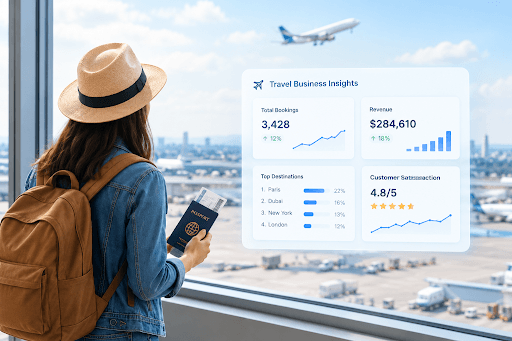
Table of Contents
Key Takeaways
- 1Streamlined Travel Operations: SaaS platforms centralize bookings, customer information, itineraries, payments, and supplier coordination in one place.
- 2Automated Customer Support: AI-powered chatbots can handle common travel enquiries, provide booking information, and assist customers with routine requests.
- 3Smarter Workflow Automation: Combining SaaS with automation and AI helps manage booking confirmations, payment reminders, schedule changes, and other repetitive tasks.
- 4Data-Driven Decisions: AI-powered insights and analytics can help travel businesses understand booking trends, cancellation patterns, customer behaviour, and operational performance.
- 5CRM Integration Matters: Integrating customer relationship management (CRM) with travel SaaS connects customer interactions, bookings, preferences, and follow-ups.
Executive Summary
The way people plan and book travel has changed significantly. Travellers expect quick responses, personalized recommendations, simple booking experiences, and timely updates throughout their journey. At the same time, travel businesses must manage bookings, customer information, payments, suppliers, and itinerary changes without letting operational complexity slow them down.
For many travel agencies and tour operators, these activities still involve a combination of spreadsheets, emails, messaging apps, and separate booking systems. As the business grows, keeping everything organized becomes increasingly difficult.
What Is SaaS in the Travel Industry?
Software as a Service (SaaS) is a software delivery model in which users access applications over the internet, typically through a subscription. Instead of installing and maintaining separate software systems, businesses can use a centralized platform to manage their operations.
In the travel industry, SaaS solutions can support everything from customer management and reservations to itinerary creation, payment tracking, supplier coordination, and business reporting.
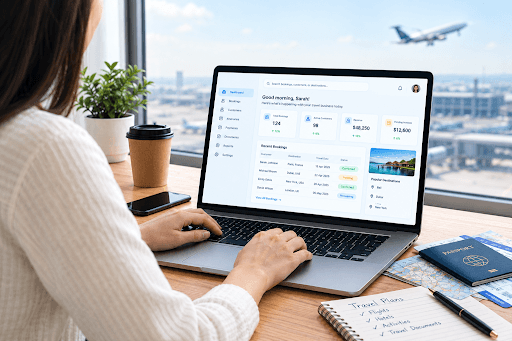
For example, a travel agency handling multiple bookings each day needs to keep track of customer preferences, travel dates, hotel reservations, flight details, payment status, and supporting documents. A travel management platform can bring this information together, making it easier for the team to access accurate, up-to-date information.
Common Features of Travel SaaS Platforms
Feature | How it helps travel businesses |
Booking management | Organizes reservations, travel dates, and booking statuses. |
Customer relationship management (CRM) | Stores customer details, preferences, and booking history. |
Itinerary management | Helps create, update, and share travel plans. |
Payment tracking | Monitors payments, balances, refunds, and outstanding amounts. |
Supplier integrations | Connects with airlines, hotels, booking providers, and other services through available APIs. |
Reporting and analytics | Provides visibility into bookings, revenue, customer activity, and operational performance. |
Role-based access | Allows team members to access the information and functions relevant to their responsibilities. |
The exact features depend on the business model. A tour operator may need supplier coordination and group itinerary management, while an online travel agency may prioritize real-time availability, pricing, and booking integrations.
The key is to build or select a platform around the actual operational needs of the business rather than adding features simply because they are available.
Why Travel Businesses Are Exploring AI?
SaaS helps organize information and business processes. AI adds another layer by helping systems interpret information, recognize patterns, and support decisions that would otherwise require significant manual effort.
Consider a customer who sends a travel agency an email requesting a seven-day holiday package for a family, including flights, hotel accommodation, airport transfers, and a preference for family-friendly activities.
AI can assist with understanding the request, extracting relevant details, suggesting suitable options, and preparing a draft itinerary. The travel consultant can then review the recommendations, verify availability and prices, and finalize the proposal.
This is a practical example of AI supporting human expertise rather than attempting to replace it.
5 Practical Use Cases of AI in the Travel Industry
1. AI-Powered Travel Planning and Personalization
Not every traveller wants the same experience. Some prioritize budget, others prefer luxury accommodation, and some want family activities, adventure experiences, or cultural attractions.
Traditional booking systems generally rely on filters and predefined search criteria. AI can help interpret more detailed customer preferences and use relevant information to suggest suitable options.
For example, a traveller might request a five-day trip with a limited budget, minimal travel between destinations, and activities suitable for young children. An AI-enabled application could help identify relevant destinations, organize potential activities, and prepare a suggested itinerary.
Depending on the available data and integrations, these systems can support:
Personalized destination and accommodation recommendations.
Draft itineraries based on budget, interests, and trip duration.
Suggestions based on previous bookings or stated preferences.
Natural-language search that allows customers to describe what they want in their own words.
Recommendations still need to account for current prices, availability, travel restrictions, and other practical constraints. AI-generated suggestions should not be treated as confirmed bookings.
2. AI Chatbots for Travel Customer Support
Travel questions do not stop after a booking is made. Customers may want to know their reservation status, payment balance, baggage allowance, cancellation terms, or whether an itinerary has changed.
An AI-powered chatbot can help answer common questions without requiring a staff member to respond manually to every request.
When connected securely to relevant business systems, a chatbot may be able to retrieve booking details, explain applicable policies, share itinerary information, or guide customers through a support request.
For example, if a customer asks, “What is the status of my hotel booking?”, the application can authenticate the customer, retrieve the relevant reservation information, and present an appropriate response.
Technologies such as Large Language Models (LLMs), Natural Language Processing (NLP), APIs, and retrieval-based systems can help support these interactions.
However, the chatbot should not invent booking details or make promises about refunds, availability, or policy exceptions. Sensitive requests and uncertain cases should be transferred to a human support representative.
3. Automated Booking and Document Processing
Travel businesses often handle booking confirmations, invoices, identity documents, hotel vouchers, and supplier correspondence in different formats.
Manually reviewing this information can take time, particularly when teams manage many customers and suppliers.
AI-assisted document processing can help extract relevant information from supported files and identify details that need to be entered into the booking system.
For example, an application may use Optical Character Recognition (OCR) to read text from a scanned document and AI-assisted extraction to identify travel dates, reservation references, passenger names, or invoice amounts.
Document security, access permissions, data retention, and applicable privacy requirements must be considered from the beginning, especially when processing identity or payment-related information.
4. Booking Updates and Operational Automation
A confirmed reservation often triggers several additional tasks. The team may need to send confirmation emails, update customer records, notify suppliers, track payments, and remind customers about upcoming travel dates.
Without connected systems, these tasks can be spread across multiple tools and depend heavily on manual follow-up.
A travel SaaS platform can automate predictable actions based on booking status, payment milestones, and scheduled dates. AI can complement this functionality by helping classify incoming messages, summarize supplier communications, or identify requests that need attention.
For example, a platform might automatically send a booking confirmation after a reservation has been verified. If a supplier subsequently sends an email about a schedule change, an AI-assisted system could identify the relevant booking and flag it for staff review.
This distinction matters: standard automation should handle predictable rules, while AI should assist with tasks that require interpreting information.
Combining the two can reduce repetitive work without giving an AI model unnecessary control over important business transactions.
5. Travel Business Analytics and Decision Support
As travel businesses grow, understanding operational performance becomes increasingly important.
Managers may want to know which destinations generate the most bookings, which packages perform well, where cancellations are increasing, or how much time staff spend handling customer requests.
A well-designed SaaS platform can collect operational data and present it through dashboards and reports. AI can add value by helping users explore that information in natural language, summarize trends, or identify patterns worth investigating.
The reliability of these insights depends on data quality, suitable access controls, and appropriate validation. AI-generated explanations should be traceable to the underlying data rather than presented as unquestionable conclusions.
SaaS vs. Automation vs. AI: Understanding the Difference
These technologies are related, but they serve different purposes. Understanding the distinction helps businesses choose the right solution for each problem.
Technology | Primary purpose | Example in travel |
SaaS | Provides access to connected business software. | Managing customers, bookings, and itineraries in one platform. |
API integrations | Allow different systems to exchange information. | Connecting a booking platform with a hotel inventory provider. |
Workflow automation | Executes predefined actions based on rules or events. | Sending a confirmation after a booking is approved. |
Artificial Intelligence | Helps interpret information, generate content, and identify patterns. | Extracting details from supplier emails or preparing a draft itinerary. |
Analytics | Turns business data into reports and useful insights. | Monitoring booking trends and cancellation rates. |
Key Benefits of Combining SaaS and AI in Travel
When implemented around clear business requirements, SaaS and AI can deliver several benefits.
1. Less manual administration
Centralized records and automated workflows can reduce repetitive data entry, follow-ups, and information transfer between tools.
2. A more consistent customer experience
Customers can access booking information more easily, receive timely updates, and get support for common questions.
3. More personalized travel recommendations
AI can help interpret customer preferences and prepare relevant suggestions, giving travel consultants a stronger starting point for their recommendations.
4. Better visibility across operations
Connected systems can make it easier to monitor bookings, payments, supplier responses, and business performance.
5. Greater flexibility as the business grows
A modular SaaS platform can be extended with new integrations, workflows, and AI capabilities as operational requirements evolve.
These benefits are not automatic. They depend on the quality of the implementation, the reliability of connected systems, the accuracy of the data, and whether the solution addresses a genuine business need.
How to Implement AI in a Travel SaaS Platform?
Introducing AI does not have to mean rebuilding an entire travel platform. A phased approach often makes it easier to control complexity, evaluate results, and improve the solution based on real usage.
Step 1: Identify the Business Problem
Start by identifying the tasks that consume the most time or create the most friction.
Is the team spending too much time preparing itineraries? Are customer requests spread across multiple channels? Are booking updates frequently missed? Is document processing slowing down operations?
Define the problem before selecting the technology.
Step 2: Review Existing Systems and Data
Identify where customer records, booking information, payments, and supplier details are stored.
Review whether the data is accessible, consistent, and suitable for integration. Existing systems may already provide APIs that can be reused, while other processes may require custom development.
This stage also helps identify security requirements and any limitations in the existing infrastructure.
Step 3: Choose the Right Technical Approach
The solution should match the problem.
For example, predefined confirmation emails may only require workflow automation. A chatbot that answers questions using approved travel policies may require a language model combined with retrieval from trusted information sources. Document extraction may require OCR, structured validation, and human review.
Depending on the use case, a solution may involve a combination of frontend applications, backend services, databases, third-party APIs, AI models, and monitoring tools.
Step 4: Build and Test a Focused Use Case
Instead of implementing every possible AI feature at once, start with a manageable use case.
For example, an AI assistant could initially help travel consultants draft responses to common customer questions. The team can evaluate response accuracy, time saved, and the number of responses that require correction before expanding its responsibilities.
Testing should cover normal situations, incomplete information, incorrect inputs, system failures, and attempts to access unauthorized data.
Step 5: Measure Performance and Improve
After deployment, review whether the solution is achieving its intended outcome.
Monitor both technical performance and business results. Use feedback from travel consultants, support staff, and customers to identify improvements.
AI implementations often require ongoing evaluation because customer requests, supplier data, business policies, and model behaviour can change over time.
The Role of CRM in Travel SaaS Platforms
Customer relationships are at the heart of every travel business. A traveller might contact an agency today to discuss a holiday, return a few weeks later to confirm the booking, and come back next year to plan another trip. Keeping track of these interactions becomes difficult when customer information is scattered across spreadsheets, emails, phone calls, and messaging apps.
This is where a Customer Relationship Management (CRM) system becomes valuable.
A CRM helps travel businesses organize customer information, track enquiries, manage communication, and maintain a record of previous interactions. When integrated into a travel SaaS platform, it can connect customer relationships with bookings, itineraries, payments, and follow-up activities.
How to Measure the Success of AI in Travel
The success of an AI-enabled travel platform should be measured through practical business outcomes, not simply by the number of AI features implemented.
Metric | What it helps measure |
Time required to prepare an itinerary | Whether itinerary creation has become more efficient. |
Average customer response time | Whether customer queries are being handled more quickly. |
Manual processing time per booking | Whether repetitive administrative work has decreased. |
Booking error rate | Whether the quality and consistency of booking information have improved. |
Customer satisfaction | Whether customers find the booking and support experience useful. |
AI response correction rate | How often staff need to correct AI-generated information. |
Cost per completed task | Whether the solution delivers value relative to its operating cost. |
Establish a baseline before implementation and compare it with performance after deployment. This makes it easier to distinguish measurable improvements from assumptions about what AI should achieve.
Frequently Asked Questions
What is AI in the travel industry?
AI in the travel industry refers to technologies that help travel businesses interpret information, personalize recommendations, automate certain tasks, and support decision-making. Common applications include customer support chatbots, itinerary assistance, document processing, and business analytics.
How does SaaS benefit travel agencies?
SaaS can help travel agencies manage bookings, customer records, itineraries, payments, and reporting through connected online applications. It can reduce reliance on disconnected tools and make information easier to access across the business.
Can AI automate travel bookings?
AI can assist with understanding travel requests, recommending options, extracting booking details, and supporting customer communication. However, confirming reservations and processing payments typically require reliable integrations, validation, and clearly defined authorization rules.
Should a travel business build custom software or use an existing SaaS platform?
An existing platform may be suitable when its features and workflows closely match the business's needs. Custom software can be more appropriate when a business needs specialized booking processes, integrations, reporting, or control over its product roadmap. The decision should account for implementation cost, flexibility, maintenance, and long-term business objectives.
How does CRM software help travel agencies?
CRM software helps travel agencies manage customer information, track travel enquiries, maintain booking history, and automate follow-ups. When integrated with a travel SaaS platform, it can connect customer profiles with bookings, itineraries, and payments. AI-powered CRM features can further assist with personalized travel recommendations, conversation summaries, and customer communication, helping agencies build stronger relationships and improve operational efficiency.