From MVP to Scalable Product: What Startups Should Build First
Key Takeaways
- 1Start with user needs: Prioritize problems that users experience rather than building features based on assumptions.
- 2Use feedback to guide decisions: Analyze user behavior, recurring requests, and product performance to identify what needs improvement.
- 3Avoid unnecessary features: Focus on functionality that delivers measurable value to users and the business.
- 4Improve gradually: Introduce automation, integrations, and performance improvements when they address real requirements.
- 5Build for sustainable growth: Maintain a secure, reliable, and flexible technical foundation without overengineering too early.
- 6Measure every improvement: Track results to understand whether new features and changes are achieving their intended goals.
Launching a minimum viable product (MVP) is an important milestone for a startup. It gives founders a way to test an idea, introduce it to real users, and learn whether the product solves a meaningful problem. But once the first version is live, a new challenge begins: deciding what to build next.
Users may request additional features. The team may identify usability issues. Investors may expect faster growth, while developers may notice technical limitations that were acceptable during the initial launch. With limited time and budget, trying to address everything at once can lead to unnecessary complexity and delayed progress.
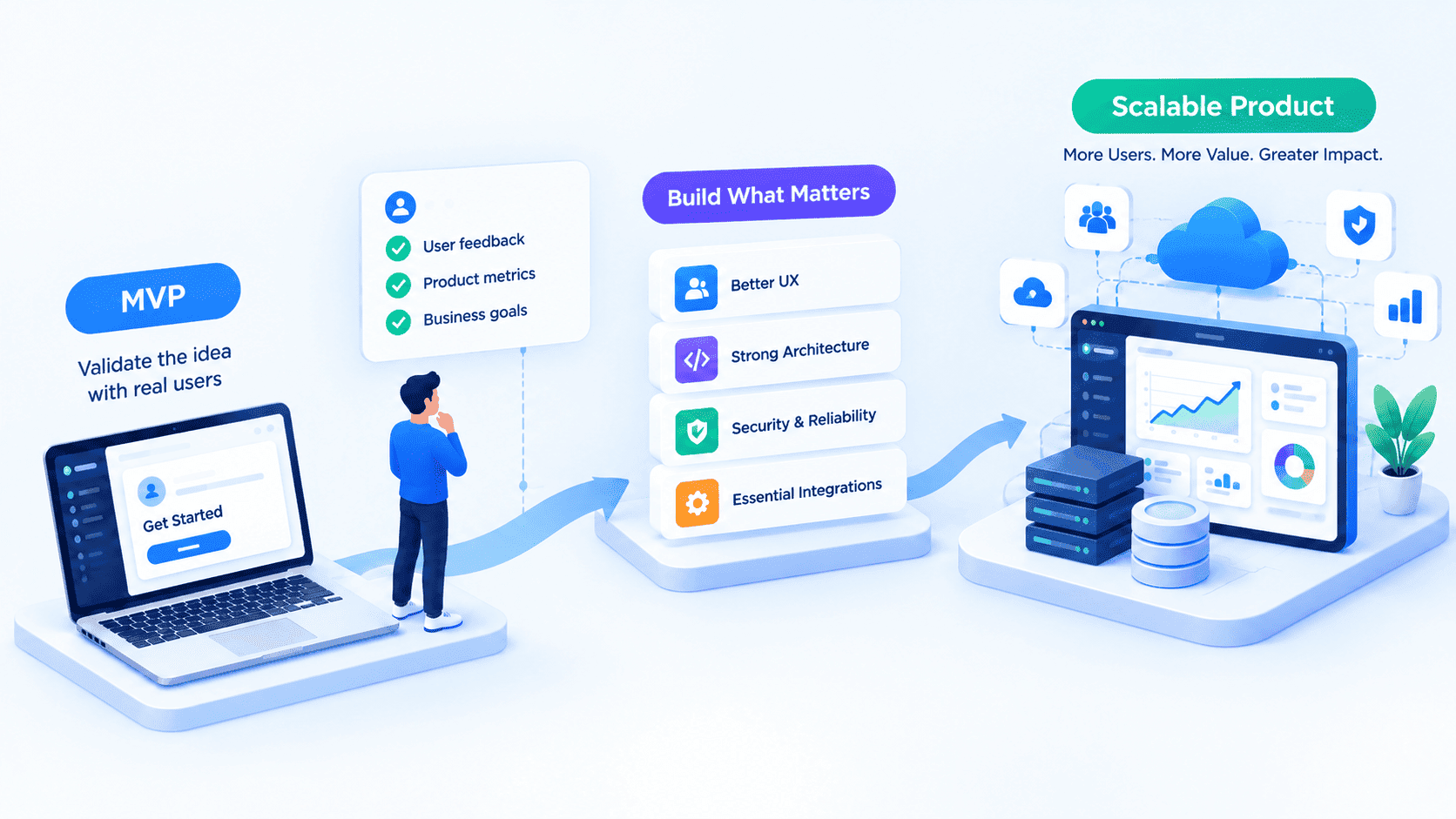
The transition from MVP to a scalable product is not about adding as many features as possible. It is about understanding what the product needs next, based on real usage, business goals, and the problems that are becoming harder to solve.
Your MVP Is Live. What Should You Build Next?
An MVP is designed to test the core value of a product with the smallest practical set of features. It is not necessarily a smaller version of the final product. Its purpose is to help a startup learn before committing more resources.
After launch, founders should look beyond the number of sign-ups or feature requests. The more useful questions are whether users are returning, whether they can complete the main task, and whether the product is becoming part of their regular workflow.
For example, imagine a startup that launches a project management platform. Users can create projects, assign tasks, and track progress. Early feedback suggests that users also want reporting dashboards, team chat, calendar integrations, and automated reminders.
Building all four features immediately may seem like progress. However, if users are struggling to set up their first project, improving onboarding could deliver more value than introducing another dashboard.
The first priority should be the change most likely to improve the product's core value—not the feature that sounds most impressive.
Three Signals That Tell You It's Time to Evolve Your Product
Not every request requires a new feature, and not every technical limitation requires an immediate rebuild. These three signals can help founders recognize when the product needs to move beyond its initial version.
1. Users repeatedly encounter the same problem
When different users report the same difficulty, it may indicate a gap in the product experience. Look for repeated support questions, abandoned workflows, incomplete registrations, or tasks that users struggle to finish.
Before developing a new capability, investigate whether the problem can be solved through better navigation, clearer instructions, or improvements to an existing feature.
2. Manual work increases as usage grows
Some processes can be handled manually when a startup has only a few customers. As the customer base expands, the same work can consume significant time.
For example, a SaaS startup might initially create customer reports manually. As more customers join, automating report generation could reduce repetitive work, improve consistency, and free the team to focus on product improvements.
Automation becomes valuable when it addresses a recurring operational problem rather than adding complexity for its own sake.
3. The product struggles to support real usage
A product that works well for a small test group may encounter difficulties as more users, records, or transactions are introduced. Pages may load slowly, data may become difficult to manage, or failures may be harder to investigate.
These are signs to examine performance, database queries, application architecture, and monitoring. The right response depends on the actual bottleneck; a complete rewrite is not automatically necessary.
The Feature Trap: Why Building More Can Slow You Down
A long feature list can make a product appear more capable, but every feature brings development, testing, maintenance, and support costs.
The problem becomes more serious when startups prioritize individual requests without considering the broader user journey. A feature may satisfy one customer while making the product harder to use for everyone else.
Before committing to development, evaluate each idea against four questions:
User value: Does it solve a meaningful and recurring problem?
Evidence: Have users experienced this problem, or is the need still an assumption?
Business impact: Could it improve activation, retention, revenue, or operational efficiency?
Ongoing cost: What will it require to maintain, support, and improve?
Consider a scheduling SaaS product. Customers request advanced analytics, but product data shows that many new users never finish creating their first schedule. Improving the setup process may help more users reach the product's core value than an advanced analytics module.
Feature prioritization is not about rejecting new ideas. It is about choosing the right sequence.
What Should Startups Build at Each Stage?
The right development priorities change as a product moves from initial validation to sustained growth.
Product stage | Main priority | What to consider building |
MVP launch | Test the core idea | Essential workflows, basic user access, and a clear way to collect feedback |
Early traction | Improve adoption and retention | Better onboarding, usability improvements, essential integrations, and relevant product analytics |
Growing usage | Reduce operational friction | Workflow automation, stronger monitoring, performance improvements, and more reliable data handling |
Expansion | Support broader business needs | More advanced permissions, additional integrations, improved infrastructure, and features validated by customer demand |
These stages are not strict milestones. A startup may need to address security early because of the data it handles, while another may need to prioritize integration with a critical customer system before investing in advanced analytics.
The goal is to make decisions based on the product's actual requirements, not follow a fixed checklist.
Make Technical Improvements When the Evidence Supports Them
Startups sometimes make one of two mistakes: they either ignore technical limitations until they become urgent, or they invest too early in infrastructure designed for a scale they have not reached.
A more balanced approach is to keep the product maintainable while improving the areas that create real constraints.
For example, a startup does not necessarily need a complex microservices architecture at launch. A well-structured application may be sufficient while the product and business model are still evolving. As requirements become clearer, the team can identify which components need to be separated, optimized, or scaled independently.
Security and data reliability also deserve attention. Appropriate access controls, secure handling of user information, backups, error monitoring, and testing help reduce risks as the product develops. These should be considered from the beginning, with the level of protection aligned to the product's data, industry, and regulatory requirements.
Scalability is not simply the ability to handle more users. It also means being able to change the product, maintain it, and introduce new capabilities without making every improvement increasingly difficult.
A Simple Test Before Starting Your Next Sprint
Before adding a feature or starting a major technical improvement, write down the problem it is intended to solve.
Then identify who experiences the problem, what evidence supports it, and how you will measure whether the change worked. Depending on the goal, useful measures might include task completion, user retention, support requests, processing time, or application response times.
Start with the smallest practical change that can test the solution. Review the results, collect feedback, and use what you learn to decide the next step.
This approach helps startups avoid committing too much time and budget to assumptions. It also creates a clearer connection between product development and business outcomes.
Turning an MVP Into a Product That Can Grow
Moving beyond an MVP requires product judgment as much as engineering effort. Startups need to recognize which user problems deserve attention, when manual processes should be automated, and when technical improvements will make a meaningful difference.
At Vivansh Infotech, product development can involve building and improving web applications, SaaS platforms, mobile products, integrations, and AI-powered capabilities. The appropriate approach depends on the product's current stage, its users, and the business outcomes it needs to support.
A successful next version does not have to be the biggest one. It should address the right problems, make the core experience more useful, and give the team a sound foundation for its next set of decisions.
The best path from MVP to scalable product is not to build everything at once. It is to learn what matters, build what is needed, and let evidence guide what comes next.
Frequently Asked Questions
What is the difference between an MVP and a scalable product?
An MVP includes the essential features needed to test a product idea with real users. A scalable product builds on that foundation with improved functionality, reliability, performance, and flexibility to support growing user needs.
When should a startup move beyond its MVP?
A startup should consider moving beyond its MVP when user feedback reveals recurring needs, usage patterns show potential for growth, or existing workflows and technical limitations begin affecting the user experience.
What should startups build first after launching an MVP?
Startups should prioritize improvements that address proven user problems. These may include simplifying onboarding, improving existing features, automating repetitive tasks, or fixing performance issues before investing in additional functionality.
How can startups prioritize features with a limited budget?
Startups can evaluate features based on user value, business impact, development effort, and available evidence. Prioritizing changes that improve user retention, product adoption, or operational efficiency helps make better use of limited resources.
How can startups make their products scalable without overengineering?
Start with a maintainable architecture, reliable data handling, appropriate security, and basic performance monitoring. Introduce more advanced infrastructure when actual usage, product requirements, or measurable bottlenecks justify the investment.
How long does it take to turn an MVP into a scalable product?
There is no fixed timeline. It depends on the product's complexity, user feedback, technical foundation, development resources, and business goals. Startups can evolve their products incrementally, prioritizing the most important improvements at each stage.